

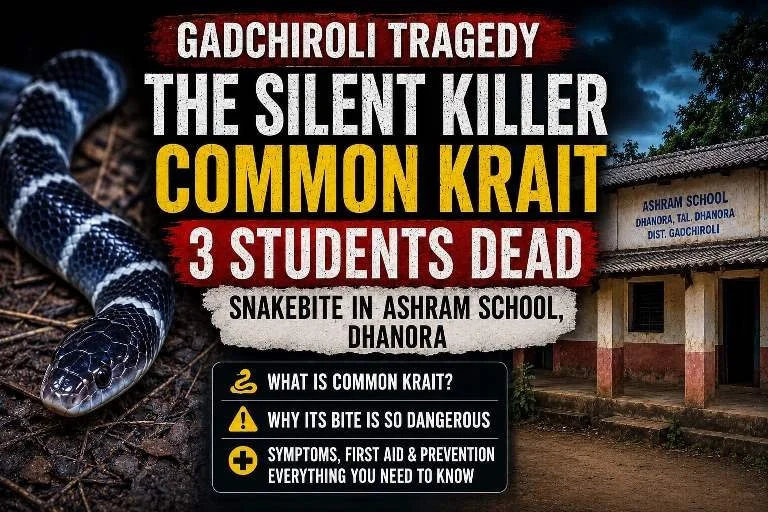
A Tragedy That Has Left Gadchiroli Grieving
Gadchiroli, Maharashtra: A tragic snakebite incident at an Ashram School in Dhanora taluka has left the local community deeply shocked and grieving. What should have been an ordinary night for children living in a residential school turned into a nightmare when several girl students were bitten by a venomous snake while they were sleeping.
Three students lost their lives, while other affected students were taken for medical treatment. The incident has not only caused immense pain to the families but has also raised serious questions about the safety of children living in residential schools located in rural and forested parts of Maharashtra.
The incident has brought renewed attention to the Common Krait (Bungarus caeruleus), one of India’s most medically important venomous snakes. Its secretive nature, nocturnal behaviour and highly potent neurotoxic venom make it a particularly dangerous snake when an accidental encounter occurs at night.

A Tragedy That Happened While the Children Were Sleeping
For children staying in an Ashram School, the hostel becomes their home away from home. They eat together, study together, play together and sleep under the care of the institution.
Parents send their children to such schools with the belief that they are safe and protected.
The Gadchiroli incident has therefore been especially painful because the students were reportedly sleeping when the snakebite occurred.
According to reports, six girl students were affected. Three of them died, while the others required medical attention. The incident reportedly occurred at night when the students were sleeping on the hostel floor.
The tragedy has naturally raised questions about hostel infrastructure, night-time supervision, emergency preparedness and the precautions that should be taken in areas where encounters with snakes are a known possibility.
But beyond the questions of responsibility and administration lies another important issue: understanding the snake itself.


Common Krait (Bungarus caeruleus) – Images
The Common Krait
The Common Krait, scientifically known as Bungarus caeruleus, is a highly venomous snake found across many parts of India.
It belongs to the Elapidae family, the same family that includes cobras.
The Common Krait generally has a glossy black or bluish-black body with narrow pale or whitish bands. Its body is relatively slender, and its head is not dramatically wider than its neck.
The Wildlife Institute of India describes the Common Krait as a medium-sized terrestrial snake and records it as one of India’s medically important venomous snakes.
Despite its dangerous venom, the Common Krait is not a snake that normally seeks out human beings. It is a secretive animal that spends much of the day hidden and becomes active primarily after dark.
That nocturnal behaviour is one of the reasons encounters with humans can become particularly dangerous.
A Snake That Moves Mainly at Night
The Common Krait is predominantly nocturnal.
During the daytime, it may remain hidden in cracks, crevices, holes, piles of debris, leaf litter or other sheltered locations. At night, it emerges to search for food.
Its diet includes other snakes as well as frogs, lizards and small animals.
In rural and forest-edge areas, snakes can sometimes enter buildings while moving through their natural surroundings. This does not necessarily mean that the snake is attacking people. Often, an encounter is accidental.
A sleeping person may unknowingly move close to or onto a snake, causing the snake to bite defensively.
This becomes particularly concerning when people are sleeping directly on the floor.
Why a Common Krait Bite Can Be So Dangerous
One of the most frightening characteristics of a Common Krait bite is that the bite itself may not always appear dramatic.
Many people expect a dangerous snakebite to cause immediate severe pain, bleeding or significant swelling.
A Common Krait bite can be very different.
Because its venom is primarily neurotoxic, the major danger is not necessarily severe local tissue damage but the effect of the venom on the nervous system.
A victim may initially have little pain or swelling at the bite site.
This can create a dangerous false sense of security.
A person who was bitten during sleep may not even realise that a snake has bitten them.
As the venom begins affecting the nervous system, symptoms can progressively develop.
How the Venom Affects the Body
The venom of the Common Krait interferes with communication between nerves and muscles.
As envenomation progresses, the muscles responsible for important bodily functions can become weakened or paralysed.
Symptoms may include:
- Weakness
- Abdominal pain or discomfort
- Drooping eyelids
- Difficulty speaking
- Difficulty swallowing
- Facial weakness
- Progressive muscular paralysis
- Difficulty breathing
In severe cases, paralysis of the respiratory muscles can lead to respiratory failure.
This is the point at which a snakebite can become rapidly life-threatening.
The patient may require intensive medical monitoring, antivenom when indicated and respiratory support, including mechanical ventilation in severe cases.
This is why a suspected Common Krait bite should never be treated as a minor injury.
The Danger of a Bite That Goes Unnoticed
The silent nature of some Common Krait bites is particularly important in a hostel environment.
Imagine a child sleeping at night.
A snake moves through the room.
The child is bitten but does not fully wake up. There may be little pain and no obvious swelling.
Nobody realises what has happened.
Several hours later, the child begins developing weakness, difficulty opening the eyes or difficulty breathing.
By that stage, precious time may already have been lost.
This is why awareness among teachers, hostel wardens, caregivers and students is extremely important.
In areas where venomous snakes are known to occur, unexplained neurological symptoms following a night spent sleeping on the floor should never be ignored.
Sleeping on the Floor and Snakebite Risk
The Gadchiroli incident has also highlighted an issue that is often overlooked: where people sleep matters in snake-prone areas.
The affected students were reportedly sleeping on the hostel floor.
The Gadchiroli district administration recommends keeping sleeping arrangements off the ground and using mosquito nets as part of snakebite prevention.
A raised bed does not guarantee protection from snakebite, and a mosquito net is not a substitute for proper hostel safety.
However, these measures can reduce the likelihood of direct contact between a sleeping person and a snake moving across the floor.
The larger solution involves the entire environment — the building, surrounding vegetation, doors, windows, drainage points, storage areas and night-time supervision.
Snakebite Is a Medical Emergency
The most important message for the public is simple:
A suspected snakebite should always be treated as a medical emergency.
The Gadchiroli district administration advises people to seek medical treatment immediately after a suspected snakebite.
There should be no waiting to see whether symptoms become serious.
There should be no assumption that a small or painless bite is harmless.
And there should be no reliance on traditional remedies instead of medical treatment.
Modern medical care, including appropriate antivenom and respiratory support when required, can save lives.
What Should Be Done After a Suspected Snakebite?
The victim should be kept calm and movement should be minimised.
The affected limb should be kept as still as reasonably possible, and tight jewellery or clothing should be removed in case swelling develops.
Most importantly, the person should be transported to an appropriate medical facility as quickly as possible.
If the snake is still present, nobody should attempt to catch, kill or handle it.
If it can be observed safely from a distance, its appearance can be remembered or photographed without approaching it.
The snake itself is not more important than the victim’s life.
Never delay medical treatment in an attempt to identify the snake.
Dangerous Traditional Practices Must Be Avoided
Even today, dangerous practices are sometimes followed after snakebite.
People may attempt to cut the wound, suck out venom, apply a tight tourniquet, use ice or depend on traditional remedies.
These practices can cause additional injury and, most importantly, waste valuable time.
The Gadchiroli district administration specifically advises against such practices and emphasises immediate medical treatment.
When dealing with a potentially venomous snakebite, there is no substitute for proper medical care.
Why Gadchiroli Needs Special Attention
Gadchiroli is a district where human settlements exist alongside extensive forests, agricultural land and natural habitats.
Snakes are therefore part of the local ecosystem.
During the monsoon, changes in water levels and the disturbance of natural hiding places can also bring snakes closer to human habitation.
This reality makes snakebite awareness especially important in rural schools, hostels, villages and agricultural communities.
The answer is not to create fear of every snake.
The answer is to understand the risks and learn how to live safely alongside wildlife.
Residential Schools Need Stronger Safety Measures
The Gadchiroli incident should encourage a broader discussion about safety in residential schools.
An Ashram School is not simply a place where children attend classes during the day.
It is also where they live.
That means safety responsibilities continue throughout the night.
Schools located in areas where venomous snakes are present should regularly inspect hostel buildings and surrounding areas.
Cracks and openings through which snakes could enter should be addressed.
Tall grass and unnecessary vegetation around hostels should be cleared.
Garbage, firewood and construction material should not be allowed to accumulate near sleeping areas.
Rodent problems should also be controlled because rodents can attract snakes.
Proper lighting should be available around hostels, particularly near toilets, pathways and entrances.
Students should have access to torches when moving outside at night.
Most importantly, staff should know exactly what to do if a snakebite occurs.
Emergency Preparedness Can Save Lives
Every residential school in a snake-prone region should have a clear emergency response plan.
Staff should know:
- The nearest hospital capable of treating serious snakebite
- How to arrange emergency transportation
- Which medical facility should receive the patient
- Who should accompany the victim
- Which local trained snake rescuer can be contacted
- What symptoms require immediate escalation
- How to communicate with parents and authorities
Emergency contact information should be readily available rather than searched for during a crisis.
When a child has been bitten by a venomous snake, every minute matters.
The Common Krait Is Part of the Ecosystem
It is important to remember that the Common Krait is not simply a dangerous animal to be killed.
Like other snakes, it has an important ecological role.
The species feeds on other snakes and small animals and forms part of the natural food chain.
People should therefore not respond to the tragedy by indiscriminately killing snakes.
Instead, snakes found inside houses, schools or hostels should be dealt with by trained personnel whenever possible.
The Gadchiroli administration also promotes safe snake-rescue practices rather than unnecessary killing of snakes.
Awareness Is the Best Protection
There is no single measure that can eliminate snakebite risk completely.
But several simple precautions can significantly reduce the possibility of dangerous encounters.
Keeping the surroundings clean, reducing hiding places, controlling rodents, using proper lighting, keeping sleeping arrangements elevated where possible, using mosquito nets and educating children and staff can all contribute to safer living conditions.
More importantly, people need to understand that a snakebite does not have to look dramatic to be dangerous.
This is particularly true when dealing with a neurotoxic snake such as the Common Krait.
A Tragedy That Should Not Be Forgotten
The loss of three young lives in a residential school is more than a tragic headline.
Behind every student is a family that trusted the institution with their child’s future.
Those families expected their children to return home with stories about school, friends, teachers and their dreams for the future.
Instead, they received devastating news.
No article can undo that loss.
But the tragedy can become a reason to improve safety.
Every residential school in a snake-prone area should ask a simple question:
If a venomous snake enters our hostel tonight, are we truly prepared?
If the answer is uncertain, the time to improve the system is not after another tragedy.
It is now.
Respect Wildlife, Protect Human Life
The Common Krait is a remarkable but highly venomous part of India’s wildlife.
Understanding its behaviour does not mean living in fear of it.
It means knowing when and where encounters are more likely, recognising the seriousness of a suspected bite and responding quickly when one occurs.
The Gadchiroli tragedy should remind all of us that snakebite prevention, awareness and emergency medical preparedness are not optional in areas where people and wildlife live close together.
For children living in residential schools, these precautions are even more important.
They deserve to sleep safely.
They deserve properly maintained hostels.
They deserve trained adults around them.
And their parents deserve the confidence that every reasonable precaution has been taken to protect them.
The most important lesson from this tragedy is therefore not simply to fear the Common Krait.
It is to understand it, respect it, prevent unnecessary encounters and ensure that when a snakebite does occur, medical help reaches the victim without delay.
Related Snake Species – Explore More on Wildlife Nest
| Snake Species / Topic | Read Article |
|---|---|
| Indian Rat Snake | Read Article |
| Common Sand Boa Snake | Read Article |
| Indian Rock Python | Read Article |
| Two Step Snake | Read Article |
| King Cobra Secrets – Study Breaks 180 Year Myth | Read Article |
| Slender Coral Snake | Read Article |
| The Green Vine Snake – An In-Depth Look | Read Article |
| Common Cat Snake – All Information | Read Article |
| Banded Krait Snake – All Information | Read Article |
| King Cobra – All Information | Read Article |
| Common Krait – All Information | Read Article |
| Russell’s Viper | Read Article |
| Saw Scaled Viper Snake – All Information | Read Article |
| Cobra Snake – All Information | Read Article |
| The Big Four Snakes of India | Read Article |
| What Are Reptiles? | Read Article |
| The Deadliest Venom | Read Article |
| Most Dangerous Snakes in the World | Read Article |
| The Ultimate Guide to Snakes | Read Article |
| History of Snakes – Evolution, Habitats, Survival | Read Article |