

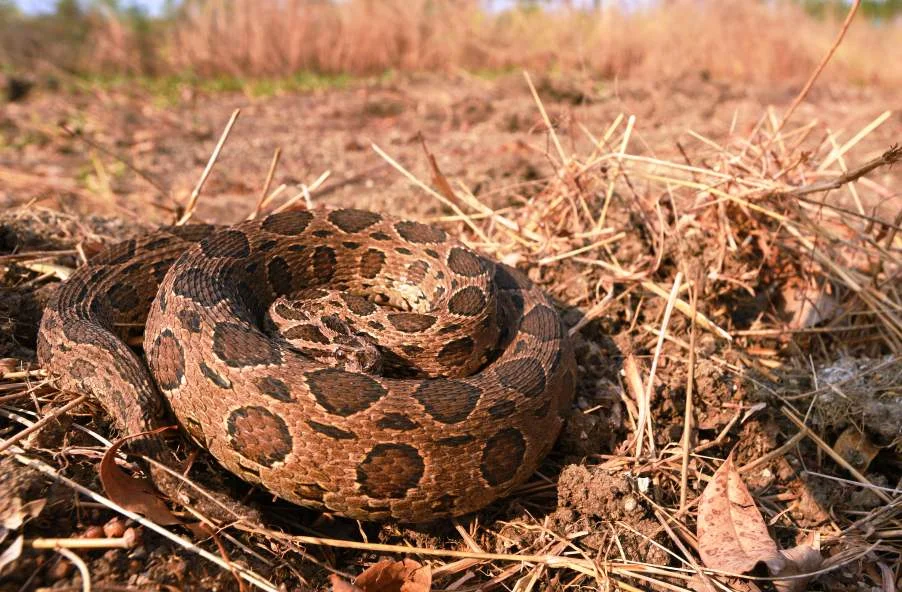
Russells Viper Snake All Information
Russell’s viper (Daboia russelii) is a large, heavy‑bodied, highly venomous viper found across much of South and Southeast Asia. It is one of India’s “Big Four” medically important snakes (along with Indian cobra, common krait and saw‑scaled viper) and is a major cause of snakebite deaths in several countries.
- Family: Viperidae (true vipers)
- Genus: Daboia (currently monotypic – only this species)
- Common English names: Russell’s viper, chain viper, chain snake, Indian Russell’s viper.
The name “Russell’s viper” honours Patrick Russell, a Scottish physician who described many Indian snakes in the 18th century.
Russells Viper Snake

Species Profile of Russell’s Viper Snake
| Attribute | Description |
|---|---|
| Snake Name | Russell’s Viper |
| Scientific Name | Daboia russelii |
| Wildlife Protection Act (WLPA) Schedule | Schedule II of Indian Wildlife Protection Act, 1972 |
| Regional Names | Indian Languages: Marathi: घोणस (Ghonas), सोन्या परड (Sonya Parad – Wardha), कांबळ्या (Kamblya – North Konkan), सूर्य कांडर (Surya Kaandar – Tal Konkan), पिरीमिटी (Pirimiti – Vidarbha), कुसडो (Kusdo – Goa), माहोळ (Mahoł – Goa), बहिर्या परड (Bahirya Parad – Chandrapur), जोगीरा (Jogira – Velha) Gujarati: તરાછ (Tarachha), ખડચિતડ (Khadchitad), કામળીઓ (Kamliyo), ઝેરી પૈડકુ (Zeri Padkoo), ઉડણેયન (Udaneyn), પડકું (Padku), પૈડકું (Paidku), ફુરસા (Fursa – sometimes also used for Saw-scaled Viper) Hindi: दबौया (Daboyya), दगाबाज सांप (Dagabaaz Saanp), घोणस (Ghonas), घो (Gho), घोड़ा (Ghoda) Malayalam: അണലി (Anali), രക്ത അണലി (Raktha Anali), വട്ടക്കൂറ (Vattakkoora), ചേനത്തണ്ടൻ (Chenathandan), മഞ്ചട്ടി (Manchatti) Tamil: கண்ணாடி விரியன் (Kannadi Viriyan) – “Glass Viper” or “Spectacled Viper” Kannada: ಕೊಳಕ ಮಂಡಲ (Kolaka Mandala), ಕಲ್ಲು ಹಾವು (Kallu Havu – sometimes also used for Saw-scaled Viper) Telugu: రక్త పింజರಿ (Raktha Pinjari), రక్త పినగ (Raktha Pinaga) Bengali: চন্দ্রবোড়া (Chandraboda), উলু বোড়া (Ulu Boda) Assamese: চন্দনচূড় (Chandanchoor), ঘোঁৰা সাপ (Ghora Xap) Oriya (Odia): ଅହିରାଜ (Ahiraja – though also used for King Cobra), ରସେଲ୍ସ ଭାଇପର (Russell’s Viper) Sindhi: કુંડલ (Kundal), જીડ (Jeed) Other Asian Languages (for Daboia siamensis, formerly considered a subspecies of D. russelii): Thai: งูแมวเซา (ngu meow sao) – “Cat-like Viper” (referring to its resting posture) Burmese: မြွေဟောက်မြင်း (Mway Hauk Myin) Khmer: ពស់វែកភ្នំ (Poah Veak Phnom) – “Mountain Viper” (though also general for vipers) Vietnamese: Rắn lục Russell (Rắn lục Russell) Malay/Indonesian: Ular Russell (Ular Russell), Ular Belang (General term for striped snake) Sinhala (Sri Lanka): තිත් පොළඟා (Thith Polonga) – “Spotted Polonga” |
| Physical Description | Heavy-bodied with a flattened triangular head, large nostrils, and a prominent snout. Its skin is yellowish-brown with three rows of dark brown oval spots bordered in black and white. Average length is 4-5 feet, can grow up to 5.5 feet. |
| Habitat | Prefers open grasslands, agricultural fields, scrub forests, and urban outskirts. Often found near water sources and rodent-prone areas. |
| Diet | Carnivorous; feeds on rodents, lizards, birds, frogs, and other small animals. |
| Behaviour | Primarily nocturnal but can be active in the day. Known for its loud hissing when threatened and for coiling into an ‘S’ position before striking. |
| Venomous or Non-Venomous | Venomous |
| Venom Type | Hemotoxic |
| Venom Effects on Prey | Causes rapid drop in blood pressure, internal bleeding, and organ failure leading to death. |
| Venom Effects on Humans | Severe pain, swelling, blistering, internal bleeding, necrosis, kidney failure, and often death if untreated. High fatality rate. |
| Common or Rare Species | Common in its range |
| Life Span | Around 15 years in the wild |
| Mating & Reproduction | Viviparous (gives live birth); mating occurs during early summer and young are born between May and August; litter size ranges from 20 to 40. |
Is Russell’s Viper venomous or Not?
Russell’s viper is highly venomous, not just “mildly poisonous”. Its venom is a complex mixture of toxins that affect blood clotting, blood vessels, kidneys and other organs, and untreated bites can be fatal.
Key points for readers:
- Venom type: predominantly haemotoxic and vasculotoxic, with strong effects on blood clotting; some neurotoxic and myotoxic components have also been reported.
- Medical importance: leading cause of serious viper envenoming in India, Pakistan, Bangladesh, Sri Lanka, Myanmar and Thailand.
- Antivenom: poly‑valent antivenoms used in India and neighbouring countries usually include Russell’s viper venom as one of the reference species.
This snake must always be treated as dangerous and never handled by untrained people.
Identification: How to Recognise Russell’s Viper
Correct identification is critical because treatment protocols differ for different species.
Size and body shape
Russell’s vipers are stout, muscular snakes:
- Typical adult length: about 1.0–1.3 m (3.3–4.3 ft) in mainland populations.
- Maximum recorded: around 1.7 m (5.5 ft), though most individuals are shorter.
- Body: thick and heavy, not slender like rat snakes or vine snakes.
The head is broad, triangular and very distinct from the neck, with large nostrils set on the sides of the snout. The tail is relatively short compared to body length, typical of many vipers.
Colour and pattern (“chain” markings)
Russell’s viper’s pattern is very characteristic:
- Ground colour: brown, brownish‑yellow or brownish‑grey, varying with region.
- Three rows of dark brown or black oval spots along the body, often with pale edges (white or light yellow) creating a “chain” appearance.
- These spots may fuse into a zigzag pattern along the dorsal midline in some individuals.
- Belly: generally whitish to pale yellow, sometimes with dark speckles.
Juveniles can be more brightly coloured, often with richer orange‑brown tones before fading with age.
Head and scales
- Large, conspicuous eyes with vertical pupils (typical viper eyes).
- A series of dark patches on the head, often including:
- Keeled scales (each scale has a raised ridge), giving the body a rough texture.
Distinguishing from similar snakes
Because many non‑venomous snakes share habitats with Russell’s viper, confusion is common.
Differences from some common species in India:
- Indian rat snake (Ptyas mucosa): long, slim body; relatively narrow head; pattern less bold; round pupils; fast‑moving and usually climbs well.
- Common sand boa (Eryx conicus): stout bodied but shorter; body often more cylindrical, head less distinct from neck; different blotch patterns, behaviour more fossorial.
- Saw‑scaled viper (Echis carinatus): much smaller, more slender, with “saw‑scales” and a distinct coiled‑S resting posture and “sizzling” sound when rubbed.
When in doubt, people should never handle or kill snakes – instead, call local snake rescuers or forest department.
Distribution: Where Russell’s Viper Is Found
Russell’s viper has a broad distribution across South and Southeast Asia.
Main range:
- South Asia: Pakistan, India, Sri Lanka, Bangladesh, Nepal, Bhutan.
- Southeast Asia: Myanmar, Thailand, Cambodia, Laos, Vietnam and parts of Indonesia.
- Some populations also extend into southern China and Taiwan, though those are often treated as a related species, Daboia siamensis (Eastern Russell’s viper).
In India, Russell’s viper occurs in many states, especially in the plains and agricultural landscapes of peninsular and northern India. It is generally less common in very high altitudes or dense rainforests.
Habitat: Where It Lives and Hides
Russell’s viper is highly adaptable and uses a range of habitats, but it favours open or lightly vegetated areas.
Common habitats include:
- Dry and moist open grasslands and scrub.
- Agricultural fields (paddy, sugarcane, other crops), especially with good rodent populations.
- Bushy edges of villages and towns.
- Plantations and secondary scrub forests.
- Foothills and lower montane slopes; usually up to around 2,300–3,000 m in some regions.
The species tends to avoid dense, closed‑canopy forests and very wet habitats like marshes and swamps. It often shelters in:
This habit of using rodent burrows is important for its ecology and also explains its closeness to human farmlands.
Behaviour: Day or Night, Aggressive or Shy?
Russell’s viper is primarily terrestrial (ground‑dwelling) and does not climb like many colubrids.
Activity patterns
- In hot weather: mainly nocturnal or crepuscular (active at dusk and night).
- In cooler conditions: more diurnal; can be seen basking or moving in the day.
Adults are often described as relatively slow and deliberate when undisturbed, but they become very defensive if threatened.
Defensive behaviour
When disturbed, Russell’s viper typically:
- Forms a series of S‑shaped coils, raising the front portion of the body.
- Hisses loudly and continuously – the hiss of a large individual is very strong and easily audible.
- Strikes forcefully, sometimes lifting much of the body off the ground and capable of multiple rapid strikes.
Juveniles can be especially nervous and quick to strike. Bites often occur when people accidentally step on or near a snake hidden in vegetation, fields, or around houses.
Diet: What Does Russell’s Viper Eat?
Russell’s viper is mainly a predator of small mammals, particularly rodents.
Diet composition:
- Primary prey: rats and mice (murid rodents) – a major reason why it is common in farmlands and villages.
- Other prey: squirrels, shrews, lizards, frogs, sometimes land crabs, scorpions, and birds.
- Juveniles: more lizards and small frogs, occasionally cannibalism on smaller snakes.
Hunting method:
- Russel’s viper usually lies in ambush: it waits concealed near rodent runs or burrows and strikes when prey passes.
- It typically bites, releases, and then follows the dying prey by scent, like many vipers.
From an ecological perspective, this snake plays an important role in controlling rodent populations, which are serious agricultural pests.
Reproduction: From Mating to Babies
Russell’s viper is ovoviviparous (also called viviparous in older sources): females retain eggs inside the body and give birth to live young.
Maturity and mating
- Sexual maturity: usually reached in about 2–3 years, depending on growth rate and food availability.
- Minimum length for breeding females is around 1.0 m.
- Mating season: varies with region but often in the cooler or early warm months (roughly late winter to early summer in parts of India).
Courtship includes male–female following and body contact; in some viper species, males engage in combat, though detailed observations in Russell’s viper are fewer.
Gestation and litter size
- Gestation: long, often over 6 months.
- Litter size: typically 20–40 young, but can range from a single offspring to over 60 neonates in exceptional cases.
- Newborn length: around 21–26 cm (8.5–10.2 inches).
Parturition (birth) in many regions peaks in the rainy or post‑rainy season, when prey is abundant. Newborns are fully venomous and capable of delivering bites.
Lifespan and Natural Enemies
In captivity, Russell’s vipers have survived for more than a decade, and some individuals may live 15–20 years, though wild lifespans are typically shorter.
Natural enemies include:
- Larger snakes (including king cobras) that specialise in eating other snakes.
- Some birds of prey such as eagles and large owls that may take juveniles.
- Mongooses and other carnivores occasionally attack smaller individuals.
Humans, however, are the main cause of deaths through direct killing, road accidents and habitat alteration.
Russell’s Viper Bite: Symptoms and Effects
For Wildlife Nest readers, this is the most critical section. Details vary by person, amount of venom injected, bite location, and time to treatment, but typical features of significant envenoming are well studied.
Local symptoms at the bite site
- Immediate or rapidly increasing pain.
- Swelling and tenderness around the bite, often spreading along the limb.
- Bruising, blistering or local tissue damage (necrosis) in some cases.
Systemic (whole‑body) symptoms
Russell’s viper venom can affect blood clotting, kidneys and other organs.
Common systemic features include:
- Bleeding from gums, nose, or at injection/needle sites.
- Blood in urine or stools, or prolonged clotting time (blood fails to clot).
- Nausea, vomiting, abdominal pain, dizziness or collapse.
- Low blood pressure and shock in severe cases.
- Acute kidney injury (reduced urine output, swelling, biochemical abnormalities) is a major cause of death.
Some survivors can develop hypopituitarism, damage to the pituitary gland leading to long‑term hormonal problems, months or years after the bite.
How fast do symptoms appear?
- Local pain and swelling: usually within minutes to a few hours.
- Systemic bleeding and clotting abnormalities: may appear within a few hours.
- Kidney involvement: often develops over hours to days, especially if treatment is delayed.
Because of this time course, early hospital treatment is essential even if the person initially feels “okay”.
First Aid: What to Do and What Not to Do
Correct first aid can save lives. Wrong methods can worsen outcomes. Guidelines below summarise widely accepted clinical advice; local protocols may vary, but the core principles are similar.
What to do immediately
- Reassure the victim
- Immobilise the bitten limb
- Remove constricting items
- Reach a hospital quickly
- If safe, note the snake’s appearance
What NOT to do
- Do not cut, incise or suck the wound – this does not remove venom and risks infection and extra damage.
- Do not apply tight tourniquets – these can cause severe tissue damage and do not reliably stop venom spread.
- Do not apply ice or electric shocks – these are ineffective and harmful.
- Do not give alcohol, kerosene, herbal concoctions or other home remedies – they delay hospital treatment and can worsen the condition.
- Do not attempt to catch or kill the snake – this leads to more bites; species can often be identified clinically or from safe photos.
At the hospital, doctors will assess clotting, kidney function and other parameters, and decide whether to give antivenom and supportive treatments like IV fluids, dialysis or blood products if needed.
Russell’s Viper and Humans: Conflict and Coexistence
Russell’s viper is so dangerous mainly because of its proximity to people and farmlands, not because it actively hunts humans.
Why bites are so common
- It favours fields and village edges where people work barefoot or with minimal protection, especially at night.
- It relies on camouflage and may not move away when people approach, increasing the chance of stepping on or near it.
- Rodent abundance around grain stores, rubbish, and houses attracts the snake into human spaces.
In some regions, Russell’s viper bites are among the top causes of death from any single environmental hazard, especially where healthcare access is limited.
Preventive measures for rural communities
- Use sturdy footwear and, if possible, a torch or headlamp when walking in fields, around houses and along paths at night.
- Keep surroundings clear of high grass, piled debris, and rodent burrows near houses.
- Store grain securely to reduce rodents, thus reducing snake attraction.
- Encourage trained snake rescuers and awareness programmes rather than indiscriminate killing of snakes.
Conservation Status and Threats
Despite its bad reputation, Russell’s viper is not currently considered globally endangered.
- IUCN Red List: generally listed as Least Concern, due to wide distribution and stable overall populations.
- Threats: road mortality, intentional killing, collection for skin, meat and venom, and local habitat changes.
Because it tolerates human‑modified habitats and uses rodent‑rich farmlands, it remains relatively common in many areas. However, heavy persecution can still lead to local declines.
Ecological Role: More Than Just a “Dangerous Snake”
Russell’s viper plays an important ecological role as a top meso‑predator in many ecosystems.
- By feeding on rodents, it helps control agricultural pests that damage crops and transmit diseases.
- As prey to larger predators like king cobras and some raptors, it participates in complex food webs.
- Its presence often indicates abundant small mammals and relatively intact open habitats.
From a conservation and education angle, Russell’s viper can be used to explain how even dangerous species have ecological value and why proper safety plus respect is better than fear and extermination.
Russell’s Viper vs Other Big Four Snakes (Key Differences)
For exam‑oriented or comparison readers, a brief comparison is useful.
| Feature | Russell’s viper | Indian cobra | Common krait | Saw‑scaled viper |
|---|---|---|---|---|
| Family | Viperidae | Elapidae | Elapidae | Viperidae |
| Head shape | Broad, triangular | Slightly broad with hood | Slightly flattened | Short, pear‑shaped |
| Pattern | Three rows of oval brown spots with pale edges (“chain”) | Hood mark (spectacles) | Narrow bands (not always obvious) | Small irregular patches, sand‑like pattern |
| Primary venom effect | Haemotoxic, nephrotoxic | Neurotoxic | Strong neurotoxic | Haemotoxic/coagulopathic |
| Typical habitat | Fields, scrub, open country | Varied, including villages | Often near human dwellings, rural | Dry, rocky, scrubby areas |
Fascinating Facts to Engage Readers
- Russell’s viper venom has been used in medical research for decades, particularly to study blood clotting and develop diagnostic tests.
- Climate change may alter the composition of Russell’s viper venom in some regions, potentially affecting how dangerous bites are and how well antivenoms work.
- A single large Russell’s viper can inject over 100 mg of dry venom in a single bite, enough to cause severe systemic effects in an adult human.
Watch Wildlife Awareness Videos
For more engaging and educational content on snakes and other wild creatures, don’t forget to visit our official YouTube channel: www.youtube.com/@WildlifeNest
Subscribe and explore fascinating wildlife stories, awareness videos, and rare sightings—all brought to you by Wildlife Nest!
Related Snake Species – Explore More on Wildlife Nest
| Snake Species / Topic | Read Article |
|---|---|
| Indian Rat Snake | Read Article |
| Common Sand Boa Snake | Read Article |
| Indian Rock Python | Read Article |
| Two Step Snake | Read Article |
| King Cobra Secrets – Study Breaks 180 Year Myth | Read Article |
| Slender Coral Snake | Read Article |
| The Green Vine Snake – An In-Depth Look | Read Article |
| Common Cat Snake – All Information | Read Article |
| Banded Krait Snake – All Information | Read Article |
| King Cobra – All Information | Read Article |
| Common Krait – All Information | Read Article |
| Russell’s Viper | Read Article |
| Saw Scaled Viper Snake – All Information | Read Article |
| Cobra Snake – All Information | Read Article |
| The Big Four Snakes of India | Read Article |
| What Are Reptiles? | Read Article |
| The Deadliest Venom | Read Article |
| Most Dangerous Snakes in the World | Read Article |
| The Ultimate Guide to Snakes | Read Article |
| History of Snakes – Evolution, Habitats, Survival | Read Article |