

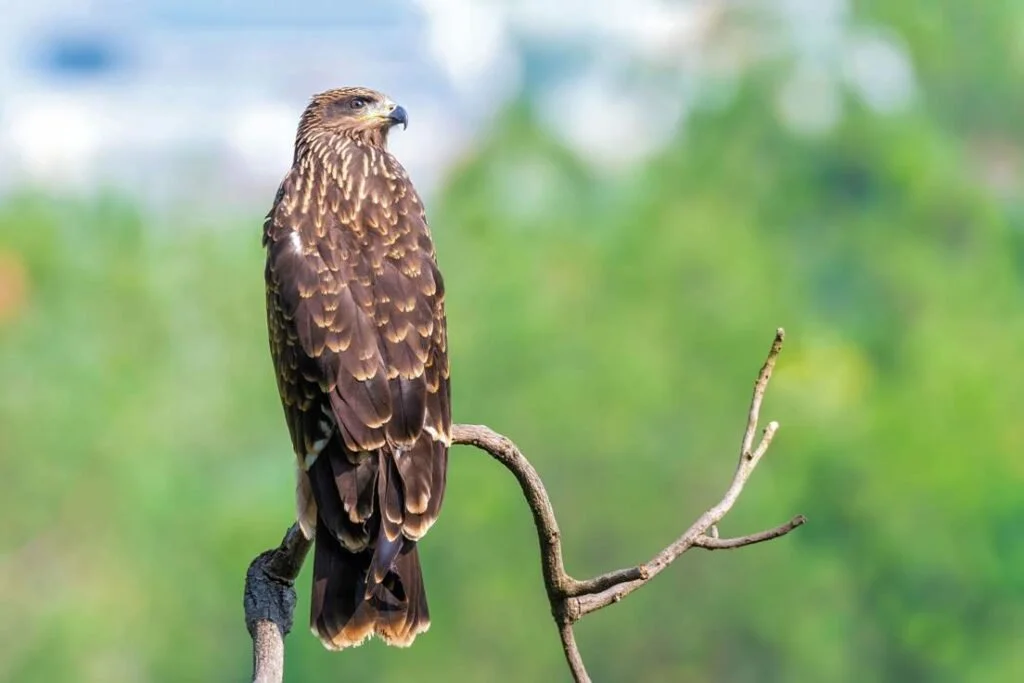
Black Kite All Information
The Black Kite is one of the world’s most widespread and adaptable birds of prey, commonly seen soaring over cities, villages, rivers and fields across India and much of the Old World. For Wildlife Nest readers, it is a perfect example of how a raptor can live alongside humans, acting both as a hunter and as a highly efficient scavenger that cleans up organic waste in our landscapes.
Basic identity and classification
The Black Kite (scientific name Milvus migrans) belongs to the family Accipitridae, which also includes hawks, eagles, vultures and other diurnal raptors. It is closely related to the Red Kite (Milvus milvus), but is more widespread and more abundant globally.
- Common English name: Black Kite
- Scientific name: Milvus migrans
- Family: Accipitridae (hawks and eagles)
- Order: Accipitriformes
- Global IUCN status: Least Concern, due to its large population and wide range.
Within this species, several subspecies are recognised, including M. m. migrans in Europe, M. m. lineatus (Black‑eared Kite) in Central and East Asia, M. m. govinda (often called the pariah or small Indian kite) in the Indian subcontinent, and M. m. affinis in Australasia. These subspecies differ slightly in size, plumage and migration patterns, but all share the same overall shape and ecology.

Image Credit – Wikimedia Commons
Size, shape and field identification
The Black Kite is a medium‑sized raptor with long wings and a slightly forked tail, giving it a very distinctive silhouette in flight. Adults typically measure about 47–60 cm in body length with an average wingspan of 140–150 cm and a body mass around 560 g.
Key identification features include:
- Long, broad wings with clearly “fingered” tips formed by separated primary feathers.
- Tail shallowly forked (less deeply forked than a Red Kite), often fanned and twisted while soaring.
- Plumage generally dark brown, appearing almost black at a distance, with slightly paler underparts and a lighter bar on the upper wing (shoulder) visible in good light.
- Head often a bit paler brown than the body in many individuals, giving a slightly hooded appearance.
- Eyes dark brown, beak black and strongly hooked, with a contrasting yellow cere and yellow legs.
In the air, Black Kites are very agile and can glide for long periods, making tight circles by just flexing their wing tips and twisting their tails. They often rock slightly in the wind and may be seen patrolling over rivers, garbage dumps or roads in groups, which is a strong clue to their identity.
Plumage and age/sex differences
Overall, Black Kites are not strongly sexually dimorphic, meaning males and females look very similar, though females can be slightly larger on average. Juveniles and immatures, however, differ somewhat from adults and can be recognised by:
- Paler, streakier underparts with buff streaks on the chest and belly.
- More obvious pale fringes to feathers giving a somewhat mottled, “scaly” look.
- Tail slightly more square-tipped in younger birds before the adult-type fork becomes obvious.
Downy chicks hatch covered in soft sepia and buff down which later gets replaced by greyish‑brown second down before the first true feathers develop. As they grow, their plumage darkens and gradually approaches the adult colour pattern over the first few years.
Distinguishing from similar species
For birders in India and Eurasia, the main confusion species is often the Red Kite or other large brown raptors like Steppe Eagles and Buzzards. Key differences include:
- Red Kite: paler, more reddish body, very deeply forked tail, and whitish patches under the wings.
- Eagles (e.g., Steppe Eagle): bulkier, broader wings, large head and powerful bill, often soaring higher and more solitary.
- Buzzards: shorter tails, broader and more rounded wings, usually more heavily patterned underparts and more flapping flight.
The combination of medium size, shallow forked tail, long “fingered” wings and tendency to gather around human waste or water bodies strongly points to Black Kite.
Global distribution and habitats
The Black Kite has one of the widest distributions of any raptor, occurring across Europe, Asia, Africa and Australia. It is absent from the Americas and Antarctica, but otherwise occupies a huge range of temperate and tropical habitats.
Broad distribution patterns include:
- Europe: breeds widely but in relatively smaller numbers; many populations migrate to Africa in winter.
- Asia: common from Western Asia through the Indian subcontinent to East Asia, including China and Japan, with both resident and migratory populations.
- Africa: widely distributed, especially in savannas, open woodlands and around towns and cities.
- Australia: represented by subspecies M. m. affinis, a largely resident raptor across much of the continent’s open country.
In India, the subspecies M. m. govinda is particularly abundant, especially in and around large cities and towns where food from human activity is plentiful. Studies in Delhi have recorded some of the highest densities of Black Kites ever documented for any raptor, with estimates of around 15–20 pairs per square kilometre in some urban areas.
Habitat preferences
Black Kites are habitat generalists but show clear preferences for:
- Open woodlands and forest edges
- Riverbanks, lakes, wetlands and coastal areas
- Farmland, grasslands and villages
- Urban and peri‑urban landscapes, particularly near garbage dumps, abattoirs, fishing ports and roads.
They usually avoid dense, closed-canopy forests but otherwise adapt well to landscapes with a mix of open and semi-open areas, trees for nesting, and abundant carrion or small prey.
Migration and movements
Migration patterns in Black Kites vary widely between subspecies and regions. Temperate populations in Europe and Central Asia are mostly migratory, moving to warmer regions during winter, while tropical populations (such as many Indian birds) tend to be resident or short-distance migrants.
Key movement patterns:
- European M. m. migrans often migrate to sub‑Saharan Africa for the winter.
- Central Asian and eastern M. m. lineatus (Black‑eared Kites) migrate towards South Asia, Southeast Asia and other milder regions.
- Indian M. m. govinda are mainly resident, though local movements related to food availability, monsoon patterns and breeding may occur.
- Australasian M. m. affinis is generally resident within Australia, with some local dispersal.
During migration, Black Kites often form large flocks and use thermal updrafts to gain height, then glide long distances with minimal flapping. They may gather in spectacular numbers at bottleneck sites such as mountain passes, coastlines or river valleys where many raptors funnel through.
Diet and hunting behaviour
One of the most important features of the Black Kite is its broad, opportunistic diet and its strong tendency to scavenge. This flexibility has helped the species to thrive in human‑dominated landscapes where other raptors might struggle.
Main food items
Black Kites are carnivorous and consume:
- Carrion and road‑kill of mammals and birds
- Offal and meat scraps at slaughterhouses, markets and garbage dumps
- Live prey such as rodents, small mammals, squirrels and bats
- Birds and their eggs or chicks taken from nests
- Fish (caught near water bodies or scavenged from fisheries)
- Reptiles and amphibians, including lizards and frogs
- Large insects such as grasshoppers, beetles and termites.
Studies of diet in urban India have confirmed that rodents, squirrels, fish, smaller birds and various invertebrates are common prey, with a significant portion of food coming from human waste and refuse. This scavenging role helps in biodegradation of organic matter and may indirectly reduce pests, though it can also expose kites to pollutants and toxins.
Foraging techniques
Black Kites employ a variety of hunting and scavenging strategies:
- Soaring slowly over fields, wetlands, roads or dumps, scanning for carcasses or small moving prey.
- Hovering over or near grass fires, catching insects and small animals flushed by the flames; in some regions, kites have been reported picking up burning sticks to spread fire and flush more prey, which has led to them being called “fire kites.”
- Patrolling along rivers or coasts to snatch fish near the surface or pick up dead fish.
- Stealing food from other birds or taking eggs and nestlings from exposed nests.
- Gathering in large numbers at garbage dumps or market areas where slaughter waste is discarded.
In cities like Delhi, Pune and many other Indian urban centres, it is common to see dozens or even hundreds of Black Kites circling above landfills, butcher shops or religious feeding sites where people throw meat scraps. This creates a very distinctive “kite skyline” familiar to many city dwellers.
Social behaviour and daily life
Black Kites are generally more social than many other raptors, especially when feeding and roosting. They may form loose flocks at good feeding spots and communal roosts in tall trees or structures within or near cities.
Daily routines typically include:
- Early morning: leaving roosts to begin soaring and foraging as thermals develop.
- Midday: extended soaring and feeding bouts, often taking advantage of rising warm air.
- Late afternoon: final feeding, then returning to communal roosts to rest for the night.
At roosts, vocal communication and mild squabbles over perches are common, but serious injuries are rare because birds can easily shift positions. During the breeding season, territories around nests become more strongly defended, and pairs may chase away intruding kites or other raptors.
Vocalisations
Black Kites are quite vocal, especially near nesting sites or communal roosts. Their typical call is a descending whinny or whistling sound, often described as a series of thin, piping notes that fall in pitch.
Common vocal behaviours include:
- Contact calls between pair members around the nest.
- Begging calls from chicks and fledglings, often high-pitched and repetitive.
- Alarm calls when predators or human intruders approach the nest or roost.
These vocalisations help maintain social bonds, coordinate parental care and signal threats.
Courtship and pair bond
Black Kites usually form monogamous pairs during the breeding season, and many pairs may remain together for several years if they continue to survive and breed successfully. Courtship behaviours include:
- Aerial displays in which the pair circles together, sometimes with swooping or brief chases.
- Mutual calling and perching close together in trees near the nesting site.
- Mate‑feeding, where the male presents food to the female as part of strengthening the pair bond.
Males returning from foraging may copulate with the female soon after arriving, which can increase the chance that his sperm, rather than that of a rival male, fertilises the eggs. Once the pair is fully bonded for the season, they begin nest building and territory defence.
Nesting sites and nest structure
Black Kites prefer to build nests in tall trees, often at heights between about 2 and 30 metres above the ground, depending on the available vegetation. They commonly choose open forests, wooded edges, avenues of roadside trees, plantations, or trees in parks and city colonies.
The nest is a platform of sticks, twigs and other plant materials lined with softer items such as grass, leaves, paper, cloth, or wool. In urban India, kites are notorious for incorporating bits of plastic, cloth pieces and other human debris into their nests, reflecting the close link between the species and human environments.
Both male and female participate in nest building, but the female often spends more time shaping and arranging materials. Nests are reused and refurbished year after year if they remain intact and the pair returns to the same territory.
Breeding season and egg laying
The breeding season of Black Kites varies with geography:
- In many parts of the species’ range, nesting occurs between March and August.
- In North India, including Delhi and surrounding regions, courtship and nest building often peak around March, with egg laying concentrated in April and May.
- In more temperate regions, the timing may shift slightly earlier or later depending on local climate and food availability.
Typical reproductive traits include:
- Clutch size usually 2–3 eggs, occasionally from 1 up to 5.
- Eggs off‑white or creamy, often marked with brown or reddish-brown speckles.
- Incubation period about 30–34 days, mainly by the female, though the male may assist briefly.
- Chicks remain in the nest for around 42–56 days after hatching.
- After fledging, young birds are still dependent on parents for an additional 2–8 weeks, receiving food and protection until they become fully independent.
Black Kites reach sexual maturity at about 2–3 years of age, after which they can breed every year if conditions are favourable.
Parental care and chick development
Parental care in Black Kites is relatively strong and involves both parents, especially during the period when chicks are small and vulnerable. In the early days after hatching, the female tends to brood the chicks to keep them warm while the male provides most of the food. As chicks grow larger, both parents participate in hunting and feeding.
Development stages include:
- Newly hatched: covered in soft down, eyes closed or only partially open, relying completely on parents for warmth and food.
- Second down stage: brownish‑grey down spreads over the body, and chicks begin to sit more upright and show more awareness of surroundings.
- Feather development: primary and tail feathers start to emerge, chicks exercise their wings in the nest, and sibling rivalry over food may become more intense.
- Fledging: first flights from the nest, often short and clumsy, with gradual strengthening of flight muscles over days to weeks.
Sibling competition can be strong, especially in food‑limited situations, and in some broods the older chick may outcompete or even attack the younger. However, in food‑rich urban or coastal environments, survival rates can be high and multiple chicks may fledge successfully.
Lifespan and mortality
Accurate data on lifespan in the wild vary by population, but many raptors of similar size can live over 10 years in favourable conditions, with maximum recorded ages sometimes exceeding 20 years. For Black Kites, survival is shaped by a range of natural and human‑related factors.
Common causes of mortality include:
- Starvation or failure to fledge when food is scarce.
- Predation on eggs or chicks by crows, owls or other predators.
- Collisions with power lines, buildings or vehicles, especially in densely built‑up areas.
- Poisoning from contaminated carcasses, pesticides, heavy metals or pollutants ingested via scavenged food.
- Deliberate persecution or hunting in some regions where raptors are viewed negatively.
Despite these threats, the species as a whole maintains a large global population, though some local declines have been noted where water pollution, pesticides and poisoning are severe.
Ecological role and ecosystem services
Black Kites play an important ecological role primarily as scavengers and as predators of small animals.
Key ecological functions:
- Scavenging: by consuming carcasses, offal and discarded meat, kites help break down organic waste, reducing the amount of decomposing material that might otherwise attract disease vectors.
- Predation on pests: by eating rodents, insects and other small animals, they can indirectly reduce pest populations in agricultural and urban settings.
- Nutrient cycling: their feeding and excretion movements transport nutrients across habitats, contributing to nutrient redistribution.
In large cities such as Delhi, Black Kites are sometimes described as “garbage raptors” because of their heavy reliance on human refuse. While this association helps them survive, it also means they are exposed to pollutants, plastics and sharp objects that can harm them.
Black Kite and humans
The relationship between Black Kites and humans is complex but often surprisingly close and tolerant, especially in South Asia.
Cultural and local perceptions
In parts of India, people sometimes deliberately feed Black Kites by throwing pieces of meat into the air, where the birds skillfully snatch them in flight. This has both cultural and religious dimensions in some communities and contributes to very high densities of kites in certain neighbourhoods.
At the same time, their presence around garbage dumps, slaughterhouses and landfills has led some people to view them as “dirty” or as nuisances, although they rarely pose direct danger to humans. Occasional incidents of kites grabbing food from people’s hands or causing minor disturbances have been reported, but serious conflicts are uncommon.
Economic and health aspects
Black Kites can provide indirect benefits:
- They help remove animal carcasses and organic waste that might otherwise attract feral dogs or rats and support disease cycles.
- By feeding on some agricultural pests and small rodents, they can support pest control, similar to the role documented for their close relative, the Red Kite.
However, there are also risks: kites feeding at heavily polluted water bodies or dumps can accumulate toxins, which may affect their health and, in rare cases, could serve as indicators of environmental contamination. Their visibility makes them useful bioindicators for monitoring pollution and ecosystem health.
Conservation status and trends
Globally, the Black Kite is classified as Least Concern on the IUCN Red List, thanks to its extensive range and large overall population. Nonetheless, not all populations are equally secure.
Documented trends and threats include:
- In some parts of Europe and Central Asia, populations have declined due to habitat loss, persecution, pollution and reduced food availability.
- In India, long‑term trends for Black Kites appear broadly stable, though recent analyses show slightly negative annual trends in some regions, suggesting subtle declines.
- Major threats include water pollution, pesticide and rodenticide exposure, poisoning from contaminated carcasses, collision with infrastructure and deliberate poisoning or shooting.
Research projects in Delhi and other cities are actively studying kite density, breeding success, diet and health in relation to urbanisation and waste‑management practices. Such work can help guide conservation and urban planning to maintain healthy kite populations while improving environmental quality.
Black Kites in Indian cities and landscapes
For readers of wildlifenest.com in India, the Black Kite is a highly familiar neighbour. The Indian subspecies M. m. govinda thrives especially in densely populated regions where food from human sources is abundant.
In Delhi, a long‑term study showed that kite density in some urban areas may reach 20 nests per square kilometre, which is extraordinarily high for a bird of prey. Similar, though usually lower, concentrations occur around garbage dumps and slaughterhouses in many other Indian cities.
Beyond cities, Black Kites are also common over:
- Agricultural fields, where they track ploughing, harvesting and burning for exposed prey.
- Rivers and lakes, where fish and other aquatic prey provide food.
- Villages and small towns, where small dumps, markets and livestock carcasses offer additional resources.
Their ability to adapt to such a wide variety of human‑modified habitats makes them one of the most visible raptors across the subcontinent.
How to observe and photograph Black Kites
For birdwatchers and wildlife photographers, Black Kites offer many opportunities to observe raptor behaviour at close range.
Some practical tips:
- Look up around garbage dumps, slaughterhouses, riverside ghats and major roads where carcasses or waste are present; kites often circle in numbers here.
- Early morning and late afternoon provide soft light and active soaring, ideal for flight photography.
- Use moderate telephoto lenses (e.g., 200–400 mm); kites can come quite close, especially if people are throwing food.
- Watch for hovering behaviour over grass fires or following tractors; this can yield dramatic hunting shots.
When watching kites, maintaining a respectful distance from nests is important, as approaching too closely can cause stress and may lead to nest abandonment or chick exposure to predators.
How to help Black Kites and urban raptors
Although Black Kites are currently common, small actions can still support healthier populations and safer coexistence.
Helpful measures include:
- Improving waste management: reducing open garbage dumps and poorly managed slaughter waste can decrease exposure of kites to plastics, toxins and pathogens.
- Avoiding poisoned carcasses: poisoning rodents or feral animals can lead to secondary poisoning of scavenging kites and other raptors.
- Protecting large trees and nesting sites in cities and villages, especially old avenue trees and groves that host multiple nests.
- Supporting cleaner rivers and wetlands by reducing industrial and sewage pollution, which benefits both fish and raptors that depend on aquatic food webs.
Citizen science projects and local bird surveys can also help track kite numbers and health, contributing valuable data to conservation initiatives.
Fascinating facts for reader engagement
To make the Black Kite more memorable for casual readers and students, a few striking facts stand out:
- It is thought to be one of the most abundant raptors in the world, thanks to its huge range and ability to live near people.
- Some Black Kites are known to hover near grass fires and may even pick up smouldering sticks, which has led to stories of them deliberately spreading fire to flush prey.
- In Delhi, kite densities around 20 nests per square kilometre may represent one of the highest raptor densities recorded anywhere.
- The species’ scientific name, Milvus migrans, refers to its migratory habits in many parts of its range, even though other populations like the Indian subspecies are mostly resident.
These points can be used as sidebars, infographics or short “Did you know?” sections to keep readers engaged on wildlifenest.com.
For Wildlife Nest, the Black Kite is an ideal flagship for urban and semi‑urban biodiversity: a bird of prey that has learned to ride our thermals, circle above our cities and convert our waste into opportunity. By observing it more closely and managing our environments more wisely, people can ensure that this adaptable raptor continues to soar over fields, rivers and skylines for generations to come.
FAQs on the Black Kite
What is the Black Kite and what is its scientific name?
The Black Kite is a medium‑sized bird of prey belonging to the hawk and eagle family, Accipitridae, widely distributed across Europe, Africa, Asia and Australia. Its scientific name is Milvus migrans and several subspecies are recognised, including the Indian “pariah” or small Indian kite (M. m. govinda).
How big is a Black Kite and how can I identify it?
An adult Black Kite is usually about 47–60 cm long, with a wingspan around 140–150 cm and a body mass of roughly 0.5–0.8 kg. In flight it shows long, slightly “fingered” wings and a shallowly forked tail, with overall dark brown plumage that can look almost black from a distance.
Where do Black Kites live and what habitats do they prefer?
Black Kites occur across a vast area from Europe and Africa through the Middle East and Indian subcontinent to East Asia and Australia, absent only from the Americas and Antarctica. They favour open and semi‑open habitats such as farmland, riverbanks, lakes, savannas and especially towns and cities where food from human activity is abundant.
Are Black Kites common in India?
Yes, the small Indian kite subspecies is one of the most abundant raptors in Indian cities and rural landscapes, especially around large urban centres like Delhi. Research in Delhi has recorded exceptionally high densities of breeding pairs, supported by plentiful waste, offal and other food resources.
What do Black Kites eat?
Black Kites are opportunistic carnivores that feed on carrion, road‑kill, offal, fish, rodents, small birds, reptiles, amphibians and large insects. In many cities they obtain a large part of their diet from garbage dumps, slaughterhouses and market waste, making them important scavengers in urban ecosystems.
Do Black Kites really follow fires?
In several regions, Black Kites gather around grass or bush fires to snatch fleeing insects and small vertebrates, making use of the disturbance created by flames and smoke. Observers have noted them circling over fire fronts and swooping down repeatedly as prey attempts to escape the burning area.
How do Black Kites breed and how many eggs do they lay?
Black Kites usually nest in tall trees, building a platform of sticks lined with softer materials such as leaves, cloth or paper. The typical clutch contains 2–3 eggs, which are incubated for about 30–34 days before hatching.
How long do Black Kite chicks stay in the nest?
After hatching, chicks stay in the nest for roughly 6–8 weeks, developing from downy nestlings into fully feathered fledglings. Even after their first flight, young birds often depend on their parents for food and protection for several more weeks until they are fully independent.
How long can a Black Kite live?
In the wild, Black Kites have been recorded living for over 20 years, with some sources reporting maximum ages of around 22–24 years. Average lifespans are somewhat lower because many young birds die in their first years due to natural and human‑related hazards.
Are Black Kites dangerous to humans or pets?
Black Kites rarely pose any serious danger to people and usually avoid close contact, though in some Indian cities they may aggressively defend nests if people approach very near. They may occasionally snatch food or small prey items, but attacks on healthy pets or humans are exceptional and typically linked to nest defence or competition at feeding spots.
What is the conservation status of the Black Kite?
Globally, the Black Kite is listed as Least Concern because of its wide distribution and large total population. However, local declines can occur due to pollution, loss of nesting trees, persecution, collisions and poisoning from contaminated carcasses or rodent poisons.
Why are Black Kites so abundant in some cities like Delhi?
In megacities such as Delhi, open garbage, slaughter waste and intentional feeding provide huge amounts of food, allowing extremely high densities of kites to build up. Tall trees, buildings and other structures supply nesting and roosting sites, creating an urban ecosystem where Black Kites are tightly linked to human habits and waste management.
How do Black Kites benefit the environment?
By scavenging carcasses and organic waste, Black Kites help clean up dead animals and meat scraps that might otherwise support disease‑carrying pests. They also hunt rodents and large insects, contributing to natural pest control in farmland and urban areas.
How can people help protect Black Kites and other urban raptors?
People can support kites by reducing the use of poisoned baits and harmful pesticides, properly managing waste and preserving large nesting trees. Supporting cleaner rivers, wetlands and green spaces in cities also benefits kites and many other bird species that depend on healthy urban ecosystems.