

The Red Vented Bulbul All Information
Spot the Red vented Bulbul in your backyard, and you’ve encountered one of India’s most charismatic birds, known for its lively chatter and striking red patch under the tail. This adaptable songbird thrives alongside humans, bringing energy to gardens and farmlands across the subcontinent.

Image Credit – Wikimedia Commons
Striking Appearance and Identification
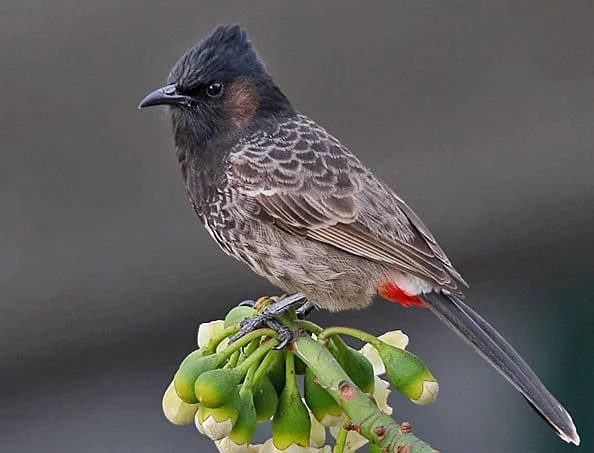
The Red-vented Bulbul measures about 20-25 cm long, with a wingspan around 27-30 cm and weight between 26-45 grams, making it a medium-sized bird easy to spot even from afar. Its head features a short, pointed black crest that gives a squarish look, while the body displays dark brown plumage with subtle scaly patterns on the back and chest. The white rump flashes brightly in flight, contrasting sharply with the unmistakable crimson-red vent beneath the tail—a key field mark that stands out when the bird perches or flicks its long, black tail tipped in white.
Both males and females share identical plumage, though juveniles appear duller with brownish edges on feathers and less vivid colors until their first molt. Subtle variations exist across subspecies; for instance, the nominate Pycnonotus cafer cafer in southern India has a darker mantle, while P. c. humayuni in arid northwest regions sports a paler brown back suited to desert fringes. In Maharashtra, common sightings match the central Indian form P. c. humayuni, often seen in urban parks like those in Nagpur or Shirpur, where their bold posture on fences draws birdwatchers. Distinguish it from similar species like the Red-whiskered Bulbul by the absence of facial whiskers and the larger red vent versus a smaller one.
Wide Distribution and Habitat Choices
Native to the Indian subcontinent, the Red-vented Bulbul resides from Pakistan through India, Bangladesh, Sri Lanka, and east to Myanmar, Bhutan, and Nepal, favoring dry scrub, open woodlands, plains, and farmlands over dense forests. In India, it dominates human-modified landscapes, with high occupancy rates around 84% in synanthropic areas of Madhya Pradesh and Maharashtra, where studies in Shirpur show denser populations near settlements than wild scrub. Maharashtra’s mix of agriculture, gardens, and urban edges in places like Nagpur or Sangli teems with them, especially during monsoons when they exploit flowering shrubs.
Globally invasive, it has spread to Fiji, Tonga, New Zealand, Hawaii, Australia, and even Argentina via human introductions, often thriving in parks and plantations. Locally, it avoids mature forests but excels in disturbed habitats; a study across 54 Indian sites pinpointed vegetation density as the top distribution driver, with Maharashtra’s cultivated lands providing ideal cover. Urban adaptability shines in cities, where they perch on wires, nest near homes, and forage in orchards, making them a fixture in Indian backyards.
Daily Behaviors and Social Life
These diurnal birds form loose flocks outside breeding season, roosting communally in dense foliage while chattering animatedly at dawn and dusk. Active foragers perch on twigs, scanning for food before sallying out for insects or hopping through undergrowth; they defend fruit patches aggressively, chasing rivals with sharp alarm calls that alert nearby birds. In Maharashtra orchards, pairs or small groups dominate fig trees, flicking tails in agitation if disturbed.
Flight is direct with bursts of wingbeats, showcasing the white rump, and they bathe enthusiastically in puddles, fluffing feathers to shake off water. Social hierarchies emerge in flocks, with dominant birds accessing prime fruits first. Their boldness around humans—snatching grapes from vines or scavenging near homes—endears them to gardeners while frustrating fruit growers. Observers in Shirpur noted higher densities in human habitats, suggesting they benefit from proximity to farms and waste.
Omnivorous Diet and Foraging Tricks
Red-vented Bulbuls devour a varied omnivorous menu: fruits like figs, berries, and guavas form 70% of intake, supplemented by nectar, flower petals, leaves, and protein-rich insects such as grasshoppers, aphids, bees, and spiders. Breeding adults ramp up insect hunting for nestlings, occasionally snatching geckos or even junk food like sev bhujia in urban Udaipur, hinting at dietary flexibility. They play dual ecological roles as seed dispersers—spreading natives like Carissa spinarum—and potential invaders abroad, aiding weeds like Lantana camara.
Foraging peaks at dawn; they probe blossoms delicately or glean caterpillars from leaves, swallowing berries whole to excrete seeds later. In Maharashtra’s farmlands, they target ripening crops, balancing pest control by eating insects but damaging orchards. Nectar from hibiscus or lantana sustains them in dry spells, while urban scraps expand options, underscoring their resilience.
Breeding Rituals and Family Dynamics
Breeding spans April to September in India, peaking post-monsoon with multiple clutches possible yearly; Maharashtra records show nests from February outliers to July peaks in Shirpur and Sangli. Monogamous pairs build cup-shaped nests 1-3 meters up in leafy shrubs like Hibiscus rosa-sinensis or dense hedges, weaving twigs, grasses, rootlets, spider silk, and lining with hair or fibers—sometimes even wires for urban flair.
Clutches hold 2-3 pale pink eggs blotched red-brown, incubated 11-14 days mainly by females, with males guarding and feeding her. Chicks fledge in 12-14 days, parents carrying fecal sacs to keep nests clean; both sexes regurgitate insects for young. Success varies: 40-70% clutches have 2-3 eggs, but predators, rains, or fires claim many fledglings in scrublands. Pied Crested Cuckoos parasitize occasionally, but vigilant parents eject intruders.
Vocal Repertoire and Communication
Noisy year-round, their signature “ginger-beer” whistle or “wheet-wheet-ear” song rings from treetops, varied by sharp “pick!” notes for alerts. Alarm calls—harsh, repetitive—rally mixed-species flocks against cats or hawks, while softer chirps greet mates. In Maharashtra recordings from 2019 capture flutelike melodies amid wind, blending with urban bustle. Calls signal food finds or territory, with roosting choruses echoing at nightfall.
Subspecies Variations Across Regions
Eight subspecies tune to local niches: P. c. humayuni rules northwest India’s deserts with pale mantles; P. c. bengalensis streaks undersides in eastern Himalayas; Sri Lanka’s P. c. haemorrhousus darkens mantles. Hybrids like P. c. humayuni x leucogenys show pale rumps. Maharashtra favors humayuni, abundant in Shirpur’s human zones.
Conservation Status and Challenges
Rated Least Concern by IUCN, populations grow overall, with no precise India-wide estimates but high local abundances like 7.24% in Madhya Pradesh surveys. Threats include habitat loss, pesticides, and nest predation by crows or cats; southern scrub fires and monsoons hit fledglings hard. Parasites like Raillietina tapeworms cause enteritis fatalities, as in one Maharashtra case. Abroad, it’s culled as invasive for crop raids and weed spread.
In India, no major declines; Maharashtra’s urban boom aids them. Predators encompass shikras, cats, and snakes; diseases like avian pox or coccidia (Isospora) lurk.
Ecological Roles and Interactions
Bulbuls disperse seeds vital for forest regeneration, like conkerberry, while predating pests boosts agriculture. In Hawaii, they skew butterfly morphs by eating orange ones preferentially. Maharashtra farms benefit from insect control but suffer fruit losses. They compete mildly with mynas but coexist in flocks.
Fun Facts and Cultural Ties
Unable to synthesize vitamin C, like humans, they source it from diet. 19th-century Indians tamed them for bazaar fights, gripping red vents. In Assam’s Bihu, males once battled captive—now banned. Melanistic or leucistic rarities thrill spotters. Maharashtra birders flock to Shirdi for mass sightings.
Conservation Tips for Backyards
Plant native berries, avoid pesticides, install nest boxes in shrubs. Report invasives abroad; support habitats via citizen science.
Red-Vented Bulbul FAQ
What size is a Red-vented Bulbul?
It is a medium-sized bird, about 20–25 cm long and weighing roughly 26–45 grams, with a pointed black crest, dark brown body, white rump, and bright red patch under the tail.
How can I recognise it easily in the field?
Look for the combination of black crest, scaly brown underparts, white rump, red vent, and white-tipped tail; this unique mix makes it hard to confuse with other common garden birds.
Where is the Red-vented Bulbul found?
It is native to the Indian subcontinent and parts of Southeast Asia, commonly seen in India, Pakistan, Nepal, Sri Lanka, Bangladesh, and Myanmar. It has also been introduced to places like Hawaii, Pacific islands, the Middle East, and New Zealand, where it lives in parks and gardens.
What kind of habitat does it prefer?
It thrives in dry scrub, open woodland, agricultural fields, village edges, gardens, and urban parks rather than dense forests. The species is strongly associated with human habitation, using hedges, small trees, and cultivated landscapes for feeding and nesting.
What does a Red-vented Bulbul eat?
Its diet is omnivorous, dominated by fruits and berries such as figs and lantana, along with nectar from flowers, seeds, and soft plant parts. It also consumes insects like caterpillars, beetles, ants, and spiders, especially during the breeding season when chicks need more protein.
Is it beneficial or harmful to farms and gardens?
It helps control insect populations and disperses seeds, supporting natural regeneration and plant diversity. However, it can damage commercial fruit crops and is considered an agricultural pest in some regions, especially where introduced.
How does the Red-vented Bulbul behave?
It is active, vocal, and bold, often perching in the open, flicking its tail, and moving in small loose groups. The species can be aggressive towards other birds at food sources and defends its feeding and breeding territories vigorously.
What sounds and calls does it make?
It produces varied, bubbly, and whistling notes often described as cheerful and musical, used for contact and song. Sharp, repeated notes and harsher calls serve as alarms when predators or intruders appear.
When is the breeding season?
In its native range, breeding typically occurs from about March/April to September, with some regional variation and often two or more broods per year.
Where and how does it build its nest?
It builds a small cup-shaped nest in low trees, shrubs, hedges, trellises, or garden plants, usually 1–3 meters above the ground. The nest is made from twigs, rootlets, grasses, leaves, and cobwebs, lined with softer materials like fine fibers and hair.
How many eggs does it lay and how long is incubation?
A typical clutch contains 2–3 pale pink to reddish-white eggs with reddish-brown blotches, heavier at the broad end. Incubation lasts about 12–14 days, with both parents generally involved in care, especially in feeding.
How long do chicks stay in the nest?
Nestlings usually fledge roughly two weeks after hatching, around 12–14 days, depending on conditions. Even after fledging, parents may continue feeding and guiding the young for some additional time.
What predators and threats does it face?
Nests and birds are vulnerable to predators such as crows, birds of prey, snakes, and domestic cats. Heavy rains, storms, habitat disturbance, and nest destruction can reduce breeding success, especially in scrub and agricultural areas.
Is the Red-vented Bulbul endangered?
No, it is currently listed as Least Concern on the IUCN Red List, with a very large range and generally increasing or stable populations. In India, it is widespread and common, and assessed as low conservation priority though monitoring continues.
Why is it considered invasive in some countries?
In introduced regions like Hawaii, New Caledonia, and parts of the Pacific, it competes with native birds, damages fruit crops, and spreads invasive plants by dispersing their seeds. Because of these impacts, it is included among the world’s worst invasive alien species and is targeted for control in some areas.
How does it help the ecosystem in its native range?
By feeding on fruits and later excreting seeds, it acts as an important seed disperser for many native shrubs and trees, aiding forest regeneration and plant connectivity. Its insect diet also helps regulate some pest populations in farmlands and gardens.
Can I attract Red-vented Bulbuls to my garden?
Yes, planting fruiting shrubs and trees like figs, mulberries, lantana, and native berry species, along with flowering plants such as hibiscus, will draw them in. Providing a birdbath, some dense foliage for cover, and avoiding chemical pesticides makes the habitat safer and more appealing.
Do males and females look different?
The sexes are similar in plumage; both have the same dark body, crest, white rump, and red vent, making them difficult to tell apart visually. Juveniles, however, tend to look slightly duller and browner with less crisp markings compared to adults.
Is the Red-vented Bulbul migratory?
It is largely resident and non-migratory across most of its range, staying in the same general area throughout the year. Some local movements and short-distance dispersal may occur in response to food availability or seasonal conditions.
Related Post
White-throated Kingfisher All Information
Indian Peafowl All Information