

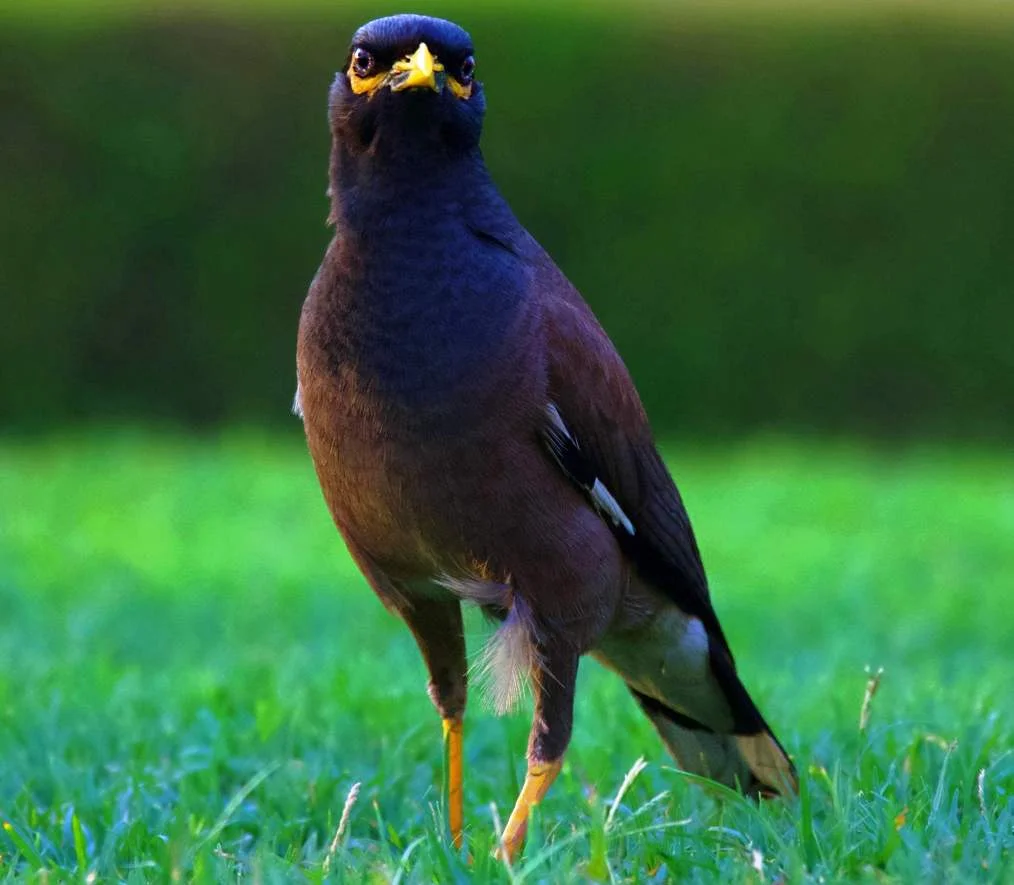
All Information on Common Myna
Common Myna (Acridotheres tristis) is one of the most familiar birds across Indian towns, cities, and villages, known for its bold behaviour, loud calls and remarkable ability to live alongside humans. It is a highly adaptable omnivorous songbird native to South Asia but now established in many other parts of the world, where in several regions it is considered a serious invasive species. This detailed article covers its identification, biology, behaviour, breeding, life cycle, ecological role, invasive impacts and relationship with humans in a way you can directly use on wildlifenest.com.

Image Credit – Pexel
Scientific classification and names
Common Myna belongs to the starling family Sturnidae in the order Passeriformes, the large group of perching and songbirds. Its accepted scientific name is Acridotheres tristis, and it is sometimes called Indian Myna, House Myna or Common Indian Myna in popular usage.
- Order: Passeriformes (perching birds)
- Family: Sturnidae (starlings and mynas)
- Genus: Acridotheres
- Species: Acridotheres tristis
This species should not be confused with the Common Hill Myna (Gracula religiosa), which has glossy black plumage and bright orange-yellow wattles; Common Myna is more brownish and lacks those wattles.
Physical identification and field marks
Common Myna is a medium-sized, stocky songbird, typically 23–26 cm in length and weighing around 82–143 g. It has a compact body, relatively long legs and a strong straight bill suited for a varied omnivorous diet.
Key identification features:
- Overall rich brown body with a glossy black head, neck and upper breast.
- Distinct bright yellow bare skin patch around the eye and yellow bill and legs, which stand out clearly.
- Large white wing patches visible in flight on both upper and lower wings; these make the bird very easy to identify in the air.
- Tail mostly dark brown to blackish with a clear white tip.
Juveniles are duller brown, with a lighter head, less glossy black, and paler or slightly whitish facial skin, which turns bright yellow as they mature. Males and females look very similar in the field, and sexing by plumage alone is generally not possible.
Voice and calls
Common Mynas are highly vocal birds with a wide range of calls, chattering notes and whistles. Their usual calls are loud, harsh, somewhat nasal notes, and in urban areas their noisy groups are often heard at dawn, dusk and at communal roosts.
They are capable of imitating other bird calls and sometimes human-related sounds, though not to the same degree as some parrots. The constant vocal communication helps maintain pair bonds, coordinate group movements, and warn of predators in their social environment.
Native range and global distribution
Common Myna is native to much of the Indian subcontinent and surrounding regions of South and Southeast Asia. Its original range includes India, Pakistan, Nepal, Bangladesh, Sri Lanka and parts of Myanmar and adjacent areas.
Through deliberate introductions and accidental escapes, it has now established breeding populations in many other parts of the world:
- Australia, especially eastern and southeastern coastal regions.
- New Zealand (mainly northern and some eastern areas).
- Several Indian Ocean islands such as Mauritius, Réunion, Seychelles, Madagascar and islands like Ascension and St Helena.
- Parts of the Middle East, southern Africa and East Africa.
- Some Pacific islands including Hawaii and other localities.
- Local populations in Florida and Hawaii in the United States.
Because of this wide spread and strong population growth in many introduced regions, Common Myna has been listed among the “100 of the World’s Worst Invasive Alien Species” in the Global Invasive Species Database.
Habitat preferences
In its native range, Common Myna primarily uses open habitats, agricultural landscapes, village surroundings and lightly wooded areas. It thrives particularly well in human-modified habitats such as towns, cities, gardens, orchards, roadside avenues and urban parks.
Typical habitats include:
- Urban and suburban streets, markets, bus stands, railway stations and residential colonies.
- Farmlands, fields, grazing lands and orchards where food is abundant.
- Edges of forests, scrublands and open woodlands, especially near villages.
It tends to avoid dense primary forests and very arid desert interiors, although it can still colonize semi-arid regions if human settlements provide water and food. Overall, it is a habitat generalist strongly associated with human presence.
Daily activity and behaviour
Common Mynas are diurnal and spend most of the day actively foraging on the ground or in low vegetation. They walk with a confident strutting gait, often in pairs or small groups, searching for insects, scraps and fruit.
Important behavioural traits:
- Boldness: They show little fear of humans, frequently foraging in busy marketplaces, near outdoor eateries, and around livestock.
- Perching: They commonly sit on electric wires, lamp posts, rooftops and tree branches, using elevated perches to scan for food and danger.
- Bathing and preening: They regularly bathe in puddles or shallow water sources and devote time to preening to keep their feathers in good condition.
- Roosting: In the evening, they gather in large communal roosts in trees, plantations or structures, creating considerable noise.
These communal roosts can contain hundreds or even thousands of individuals in some urban areas, and droppings from concentrated roosts may create local sanitation concerns.
Social structure and territoriality
Common Mynas usually form long-term monogamous pairs, with the pair maintaining a breeding territory around the nest site. Outside the breeding season, birds often form loose flocks for feeding and roosting, which offers safety in numbers.
The species is known to be quite aggressive around nest sites and feeding areas:
- Pairs defend tree cavities, building crevices, nest boxes and other hollows vigorously against other mynas and other bird species.
- They may chase away smaller birds from feeders, food scraps or fruiting trees, using both vocal threats and physical attacks.
This combination of social roosting and strong local territorial defence contributes to their success as an urban-adapted bird and, in some regions, to their negative impact on native cavity-nesting species.
Diet and feeding ecology
Common Myna is a highly opportunistic omnivore, which means it takes advantage of many different food types depending on availability. This flexible diet is a key factor in its ability to survive in diverse environments and urban landscapes.
Typical diet components include:
- Insects and other invertebrates: beetles, grasshoppers, caterpillars, termites, ants, flies, worms and other arthropods hunted on the ground or in low vegetation.
- Fruits and berries: figs, cultivated fruits, berries and seeds from various trees and shrubs.
- Human food waste: rice, bread crumbs, leftovers, fast food scraps, and items picked from garbage and street corners.
- Small vertebrates and eggs: in some cases, they may eat small reptiles, nestling birds or eggs of other species, especially in introduced habitats.
In parts of its native range, farmers have traditionally considered the bird a “farmer’s friend” because it consumes large numbers of agricultural insect pests in fields. However, in orchards and grain crops it can also feed on fruit and grain, causing some economic damage.
Breeding season and nesting sites
In most of its native South Asian range, Common Myna typically breeds from around March to September, though the exact timing may vary with local climate and rainfall. In warmer regions and in some introduced areas, they may breed for a greater part of the year when food and nesting sites are available.
Nesting site preferences:
- Natural tree cavities in old trees, palms or broken branches.
- Holes in buildings, under roof tiles, ventilator openings, ledges and crevices in walls.
- Man-made structures like lamp posts, sign boards, drain pipes, and sometimes nest boxes.
They are highly flexible in choosing nest sites and may nest quite close to humans, even on signboards or in store signs, as long as there is a cavity or niche for the nest. Their willingness to use a wide variety of cavities is one reason they are such strong competitors in urban ecosystems.
Nest construction and eggs
Both members of the pair typically participate in gathering nesting materials. The nest itself is usually a loose, bulky structure of twigs, grass, roots, leaves and various soft materials, arranged inside a cavity, crevice or other sheltered spot.
Interestingly, Common Mynas often incorporate unusual materials such as:
- Pieces of paper, tissue and cardboard.
- Plastic scraps, foil, string and cloth.
- Occasionally shed snake skins or other available debris.
The normal clutch size is about 3–6 eggs, varying slightly by location and season. The eggs are typically smooth and glossy, with colours ranging from pale blue to blue-green or turquoise, sometimes described as sky blue or azure.
Incubation, hatching and chick development
The incubation period in Common Myna generally lasts around 12–18 days, depending on local conditions and the particular study. During this time, one or both parents take turns warming the eggs, though in many passerines the female incubates more.
Key stages:
- Hatching: Chicks emerge naked and blind, completely dependent on parental care, which classifies them as altricial.
- Nestling period: The young remain in the nest for about 22–30 days, during which both parents feed them frequently with insects and other high-protein foods.
- Fledging: After about three to four weeks, chicks leave the nest but may continue to receive food and protection from parents for several weeks.
In some cases, Common Mynas may raise more than one brood in a breeding season, especially where food is abundant and climate is favourable. In its native range, studies indicate they can produce 1–3 broods per year.
Reproductive strategies and success
Common Mynas display several traits that contribute to high reproductive success:
- Early maturity: Some individuals may start breeding at less than one year of age, though many breed from their second year.
- Multiple broods: Raising more than one brood in a breeding season boosts their population growth potential.
- Nest flexibility: Ability to use a wide range of natural and artificial cavities reduces nesting limitation.
However, nest success is not guaranteed, and factors such as predation, storms, nest site failures and competition can lead to egg or chick losses. In their native range, Asian Koels (Eudynamys scolopaceus) sometimes lay eggs in Common Myna nests, making the myna a host of brood parasitism in some situations.
Lifespan and mortality
Field and banding studies suggest that the average life expectancy of Common Myna in the wild is around 4 years, although some individuals can live up to around 10–12 years under favourable conditions. In captivity or controlled environments, lifespans can be longer because of protection from predators and regular food supply.
Major causes of mortality include:
- Predation by raptors, crows, cats, snakes and other predators on eggs, chicks and sometimes adults.
- Starvation and harsh weather, particularly during droughts or in urban environments where food waste fluctuates.
- Accidents involving vehicles, collisions with structures or electrocution on power lines.
Human control efforts in some countries also contribute to mortality, because Common Myna is actively managed as a pest and invasive species in those regions.
Ecological role in native range
In its native South Asian range, Common Myna plays several ecological roles:
- Insect control: By consuming large numbers of insects, including many herbivorous pests, it can help reduce pest populations in agricultural fields.
- Seed dispersal: By feeding on fruits and then dispersing seeds through droppings, it can aid in the regeneration of some plant species.
- Scavenging: Feeding on food scraps helps clean up organic waste in villages and cities to some extent, though it may also spread certain pathogens.
Because it co-evolved with many other South Asian species, it is part of a long-established ecological network in its native habitats, although very high densities near cities can still affect some local birds through competition for nesting sites.
Invasive status and impacts outside India
Outside its native range, Common Myna is widely regarded as an invasive alien species. It has been introduced intentionally in several countries to control insects in plantations and accidentally through the pet trade or escapes, after which it has spread rapidly.
Key documented impacts:
- Competition for nest cavities: Common Myna aggressively competes with native cavity-nesting birds (and sometimes small mammals) for hollows, often evicting them or preventing them from breeding successfully.
- Predation: On some islands and in certain habitats, Mynas have been recorded preying on eggs and chicks of native birds, increasing nest failure rates.
- Crop damage: In some regions, they feed on fruit, vegetables and grain crops, causing economic losses for farmers.
- Disease and hygiene: Large communal roosts in urban centres can create issues with droppings, odour, noise and potential disease transmission.
Because of such impacts, Common Myna is one of the few birds to be included in global lists of “worst” invasive species, and some countries have formal management, trapping and control programs targeting it.
Conservation status
Despite its invasive status in many regions, the global conservation status of Common Myna is currently listed as Least Concern on the IUCN Red List. This category reflects its very large range, high population numbers and overall increasing or stable trends in most areas.
In India and much of its native range, the species is abundant and not considered threatened. However, local management and control may still occur in specific contexts, such as airports, urban roosting sites or where it damages crops or displaces native species.
Human–myna relationship
The relationship between humans and Common Myna is complex and varies by location:
Positive aspects:
- In India, it has sometimes been called a “farmer’s friend” because of its insect-eating habits in agricultural fields.
- Its bold behaviour, vocal nature and close association with people make it a familiar and interesting bird for urban birdwatchers.
Negative aspects:
- In many introduced regions, farmers and conservationists see it as a major pest and competitor to native wildlife.
- Large, noisy roosts and droppings in city centres can be considered a public nuisance.
Historically, Common Mynas have also been kept as cage birds and are sometimes valued for their ability to mimic sounds and their interactive behaviour with humans. However, trapping for the pet trade can contribute to introductions when birds escape or are released in non-native regions.
Management and control in invasive regions
In countries where Common Myna is invasive, various management strategies are used:
- Trapping: Special cage traps baited with food and sometimes live decoy Mynas are used to capture birds for humane euthanasia or removal.
- Nest box design: Installing nest boxes with small entrance holes favours smaller native birds while excluding Mynas, reducing their nesting success.
- Habitat management: Reducing accessible roost trees near sensitive sites, covering building cavities, and managing waste to limit food sources.
Public awareness campaigns often encourage people not to feed Mynas intentionally and to support native species through suitable plantings and nest boxes. These measures aim to protect native biodiversity while keeping urban ecosystems balanced.
How to observe Common Myna ethically
For bird enthusiasts and photographers, Common Myna offers many opportunities to learn about urban ecology:
- Observation sites: Markets, railway stations, bus stands, parks, street-side trees, and agricultural fields are ideal places to watch their behaviour.
- Behaviour cues: Note their foraging style, pair bonding, territorial displays and interactions with other species at feeding spots.
Ethical guidelines:
- Avoid disturbing active nests; keep a respectful distance, especially during breeding season.
- Do not offer processed junk food; if feeding is necessary, use small amounts of healthy, appropriate foods and avoid creating dependency.
- Support local biodiversity by planting native trees and shrubs that benefit a variety of bird species, not only Mynas.
By observing them carefully, one can better understand why this species is so successful and how urban and rural landscapes influence bird communities.
Key facts at a glance
This comprehensive overview presents Common Myna as a highly adaptable, intelligent and sometimes problematic bird whose success is closely tied to human activity, especially in urban and agricultural landscapes.
Watch Wildlife Awareness Videos
For more engaging and educational content on snakes and other wild creatures, don’t forget to visit our official YouTube channel: www.youtube.com/@WildlifeNest
Subscribe and explore fascinating wildlife stories, awareness videos, and rare sightings—all brought to you by Wildlife Nest!