

Rock Pigeon All Information
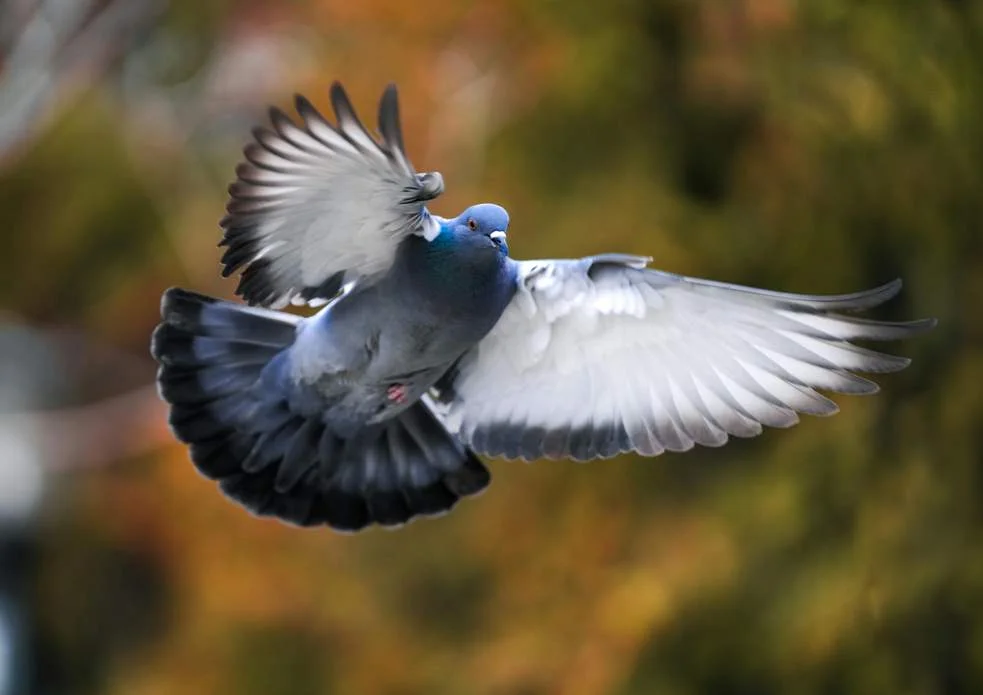
The Rock Pigeon (Columba livia), also known as the rock dove or common pigeon, belongs to the family Columbidae and originates from southern Europe, North Africa, and western Asia. This species measures 29-37 cm in length, weighs 238-380 g, and has a wingspan of 50-72 cm, featuring a plump body, small head, short legs, broad pointed wings, and a wide rounded tail. Wild individuals display blue-gray plumage with iridescent green, purple, and bronze on the neck, two black wing bars, white rump, black tail band, and red feet, though feral populations show varied colors from domestication.

Image Credit – Pexels
Taxonomy and Subspecies
Formally described in 1789 by Johann Friedrich Gmelin, the Rock Pigeon resides in the genus Columba, with closest relatives including the hill pigeon and snow pigeon. It encompasses multiple subspecies, such as the nominate C. l. livia from Europe, darker C. l. gymnocycla from Senegal to Nigeria, smaller C. l. canariensis in the Canary Islands, and C. l. palaestinae from Syria to Arabia, with others like C. l. schimperi, C. l. gaddi, and C. l. intermedia varying in size, plumage darkness, and range across Africa and Asia. These variations arose from geographic isolation, influencing adaptations to local cliffs and coasts.
Distribution and Habitat
Native to coastal cliffs and rocky areas in its original range, the Rock Pigeon now thrives worldwide due to human introduction, with feral populations spanning cities, farms, and open country across all continents except Antarctica. In India, it inhabits open country with cliffs and rocky hills throughout the country, including Assam, often as a semi-domesticated commensal near human settlements. Urban and suburban environments provide artificial cliffs like building ledges, bridges, and roofs, while rural areas offer barnyards and fields; global population estimates reach 120 million, classified as Least Concern by IUCN.
Physical Characteristics and Identification
Adults exhibit a dark bluish-gray head, neck, and chest with glossy iridescence in yellow, green, reddish-purple on the neck, orange-red eyes, gray-black bill with white cere, and purplish-red feet. Plumage variations in feral birds include white, red, brown, or black forms, but wild types retain the classic slate-gray with metallic neck sheen. In flight, they show white rump, black-tipped wings, and produce a distinctive clapping sound on takeoff, signaling alarm to flocks.
Diet and Feeding Behavior
Primarily granivorous, Rock Pigeons consume seeds like grains, wild oats, barley, wheat, millet, and grass seeds, supplemented by small invertebrates such as worms, insect larvae, spiders, or berries. Feral urban birds scavenge human discards including bread, popcorn, peanuts, rice, peas, cheese, and fast food scraps. They forage on the ground in flocks of 50-500, drink by sucking water directly without head-tilting, and occasionally climb trees awkwardly for berries.
Breeding and Reproduction
Breeding occurs year-round but peaks in spring-summer, with 1-6 broods annually; clutch size is 1-3 white eggs incubated 17-19 days by both parents. Nests form flimsy platforms of twigs, grass, straw, and debris on cliffs, ledges, roofs, or buildings, often reused and built up over time by the female using male-supplied materials. Altricial chicks, called squabs, hatch helpless with sparse down, fed crop milk—a regurgitated nutrient-rich secretion—for the first days, fledging in 25-32 days (up to 45 in winter), and staying with parents 1-2 weeks post-fledging.
Courtship and Mating
Pairs often mate for life; males select sites, coo to attract females, perform bowing, pirouettes, tail-spreading, chest-puffing, and regurgitate food in courtship feeding. Mating involves brief cloacal contact with the male balancing atop the crouching female while flapping wings. Both parents share incubation (male mid-morning to afternoon, female overnight) and brooding.
Behavior and Flight
Gregarious outside breeding, Rock Pigeons flock while foraging, roosting, and flying in undulating patterns at 15-97 mph, using direct flight with rapid wingbeats. They exhibit strong homing instinct via magnetoreception, sun position, sound, or smell, enabling trained pigeons to return from 1,800 km. Sedentary wild birds rarely migrate, but feral ones stay near food sources; alarm triggers noisy flock takeoffs.
Vocalizations
Rock Pigeons produce soft guttural cooing songs, anxious grunts as alarm calls, rattles, hoots, and wing-clap noises on takeoff. Coos feature deep two-part rising notes, varying by context like courtship or territory.
Lifespan, Predators, and Health
Wild lifespan averages 3-5 years, up to 15+ in captivity, with urban ferals reaching 7 years; first-year mortality nears 90% from predators like Peregrine Falcons, hawks, or human persecution. Common diseases include intestinal helminths (Capillaria columbae, Ascaridia columbae) and ectoparasites like lice (Columbicola columbae) and mites (Dermanyssus gallinae).
Human Relationships and History
Domesticated around 4,500 B.C. for meat and messaging, Rock Pigeons spread globally via ships, becoming feral urban icons and supporting urban raptors. In India, they hold Vedic ritual significance as ominous birds warding evil, appear in Hindu symbolism for innocence, and feature in colonial-era racing and shooting sports. Pigeon racing, developed in 19th-century Belgium and England from homing breeds, uses their navigation for competitive long-distance flights timed by clocks.
Conservation and Management
Least Concern globally due to abundance, but locally managed as urban pests via trapping, poisoning, barriers like porcupine wire, or sonic devices with minimal impact on natives. Climate models predict range shifts, though adaptability favors persistence.
Rock Pigeon FAQs
What is the scientific name and origin of the Rock Pigeon?
The Rock Pigeon (Columba livia) originates from southern Europe, North Africa, and western Asia, where it nested on coastal cliffs and rocky areas. Domesticated over 5,000 years ago, as shown in Mesopotamian tablets and Egyptian hieroglyphics, it spread globally through human activity.
How do Rock Pigeons look, and what are their size measurements?
Rock Pigeons measure 29-37 cm long with a 50-72 cm wingspan and weigh 238-380 g, featuring a plump body, small head, short legs, broad pointed wings, and rounded tail. Wild types have blue-gray plumage with iridescent neck sheen, two black wing bars, white rump, and red feet, while feral birds show varied colors like white or brown.
Where do Rock Pigeons live, especially in India?
They thrive in urban areas, farms, parks, and cliffs worldwide, except Antarctica, adapting to building ledges as artificial cliffs. In India, they occupy open country, rocky hills, and human settlements across regions like Assam and Maharashtra.
What do Rock Pigeons eat, and how do they feed?
Primarily seeds, grains, and grass seeds, supplemented by scraps, insects, or berries; urban birds scavenge bread and fast food. They forage in flocks on the ground and drink by sucking water directly into their beaks without tilting heads.
How do Rock Pigeons breed and care for young?
They breed year-round, laying 1-2 white eggs in flimsy twig nests on ledges, with 17-19 day incubation by both parents. Chicks (squabs) receive crop milk—a regurgitated nutrient-rich secretion—for initial days, fledging in 25-45 days.
What are Rock Pigeon vocalizations and behaviors?
They produce soft cooing songs for courtship, grunts for alarm, rattles, and wing-claps on takeoff. Gregarious flocks fly undulating at 15-97 mph, often staying near food sources without true migration.
How do homing pigeons navigate back home?
They use a “map and compass” system involving Earth’s magnetic fields, sun position, visual landmarks, low-frequency infrasound, and possibly smell. Trained birds return from distances up to 1,800 km, following familiar routes or stereotyped paths.
What is the lifespan of Rock Pigeons, and what threatens them?
Wild birds live 3-5 years on average (up to 15 in captivity), with high first-year mortality from predators like falcons or human control. Diseases include parasites like lice and helminths; urban pests face trapping or poisoning.
Are Rock Pigeons pests, and how can they be managed?
Often viewed as urban nuisances for droppings and fouling, control includes spikes, netting, sloping surfaces, nest removal, or feeding bans. Humane methods like birth control or barriers work best without harming natives.
What myths exist about Rock Pigeons, and what are the facts?
Myth: Pigeons are stupid—fact: they recognize human faces, distinguish art like Picasso from Monet, and perform tricks. Myth: They build only flimsy nests—fact: this shows adaptability, as squabs survive on crop milk despite poor structure. They symbolize fidelity in cultures due to lifelong pairing.